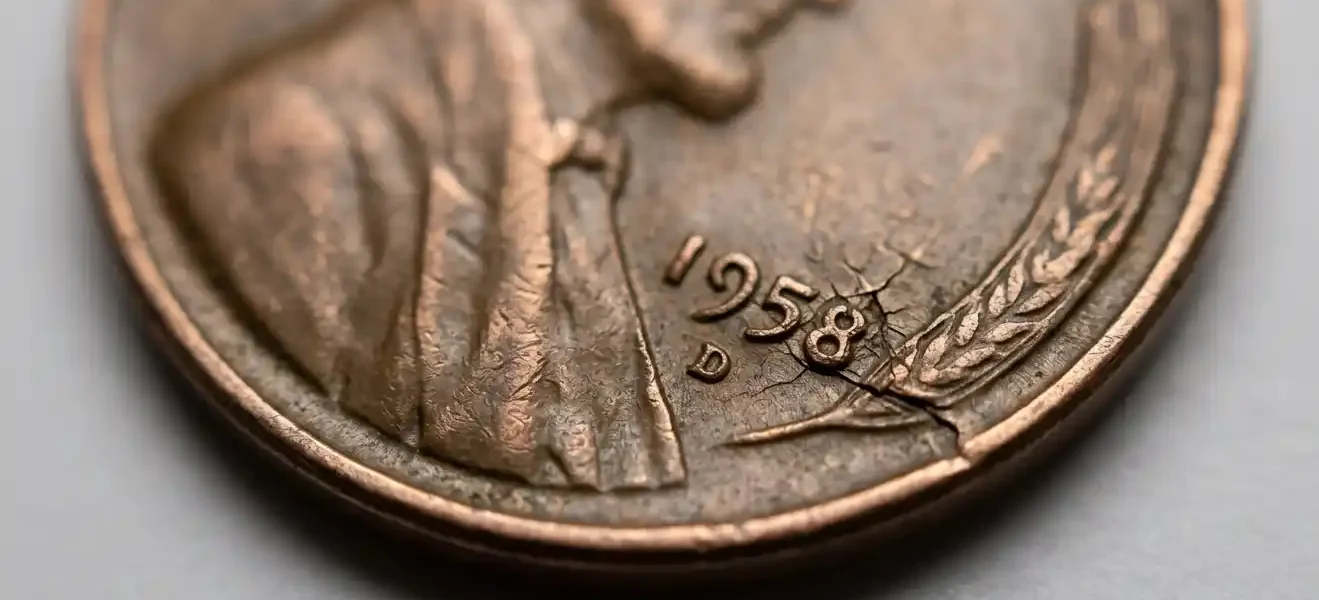

This issue demonstrates a shifting market value driven by niche demand.
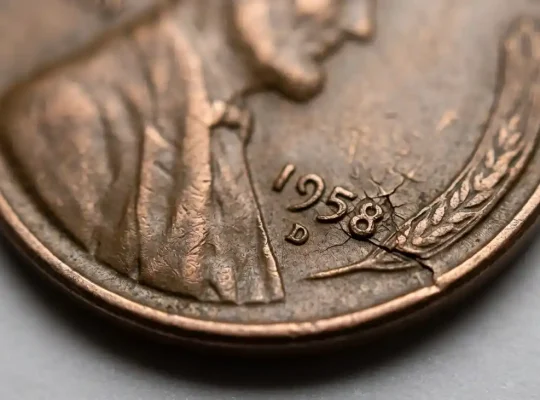
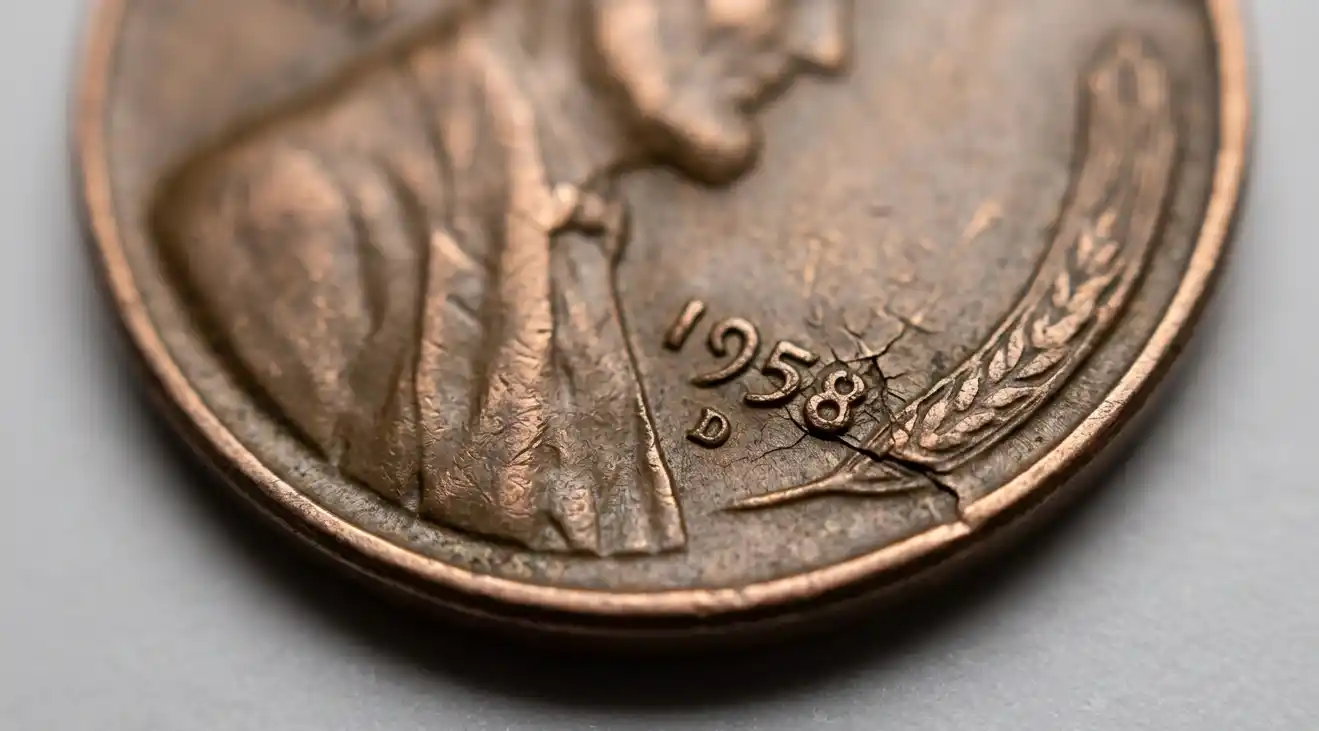
The 1958 production cycle marked the final stage for the wheat ears reverse design.
Massive circulation numbers long hid the presence of critical minting 1958 penny errors.
Characteristic
Parameter
Metal Content
95% Copper, 5% Tin, and Zinc
Mass
3.11 grams
Diameter
19.05 millimeters
Thickness
1.55 millimeters
Edge Type
Plain
Mint Facility
Philadelphia and Denver
Mass deviation exceeding 0.15 grams indicates a counterfeit or extreme wear.
Using copper as the primary metal makes the coin prone to oxidation.
Doubled Die Obverse
The variety featuring deep doubling of inscriptions and the date remains the main object of interest.
An error occurred following incorrect alignment of the hub and the working die.
Only three confirmed specimens currently exist in this category.
Identification processes require a free coin appraisal app and ten-fold magnification of the LIBERTY legend and the 1958 date.
Price trends for a specimen in MS64 condition:
2018 — $1,136,000
2023 — $1,250,000
2026 — $1,480,000
Annual growth rates average approximately 7.2%.
Difficulty in finding new units keeps the deficit at an extreme level.
Off-Center Strikes
Technological failures in planchet feeding result in partial loss of the image.
Value depends directly on the offset percentage and date visibility.
5% Offset → $15 price
25% Offset → $85 price
50% Offset with full date → $450 price
Specimens retaining more than 60% of clear field area attract researcher attention.
Deformation of the circle during the strike creates a unique item contour.
Similar lots sell on specialized platforms within 48 hours.
BIE Errors and Die Defects
Cracks on the working tool leave raised metal lines on the coin surface.
A tiny extra element appearing between letters B and E in LIBERTY defines a BIE type defect.
This type of minting flaw occurs more frequently than other categories.
Coin Condition
Price Per Unit in 2026
Circulated (VF)
$2
Uncirculated (MS63)
$12
Exceptional (MS65 Red)
$45
Bright red copper color presence increases item liquidity by 30%.
Metal darkening to a brown state reduces value by 15% annually.
Evaluation Mechanics
Professional certification eliminates subjective factors during quality determination.
A 1 to 70 point scale serves as the international verification standard.
Evaluation of strike depth on central elements
Analysis of micro-scratches on the field
Verification of mint luster intensity
Each point above MS66 increases the price in progression.
The difference between MS66 Red and MS67 Red for 1958-D reaches $400.
Using plastic slabs prevents further copper degradation.
Denver Mint Statistics (1958-D)
Total production reached 800,953,300 units.
Massive mintage notwithstanding, coins with sharp strikes remain rare.
1958-D MS67 Red — 145 units recorded
1958-D MS67+ Red — 12 units recorded
Record pricing for MS67+ in 2025 reached $3,150.
Markets show saturation in low grades while maintaining a vacuum in the top segment.
Planchet Defects and Inclusions
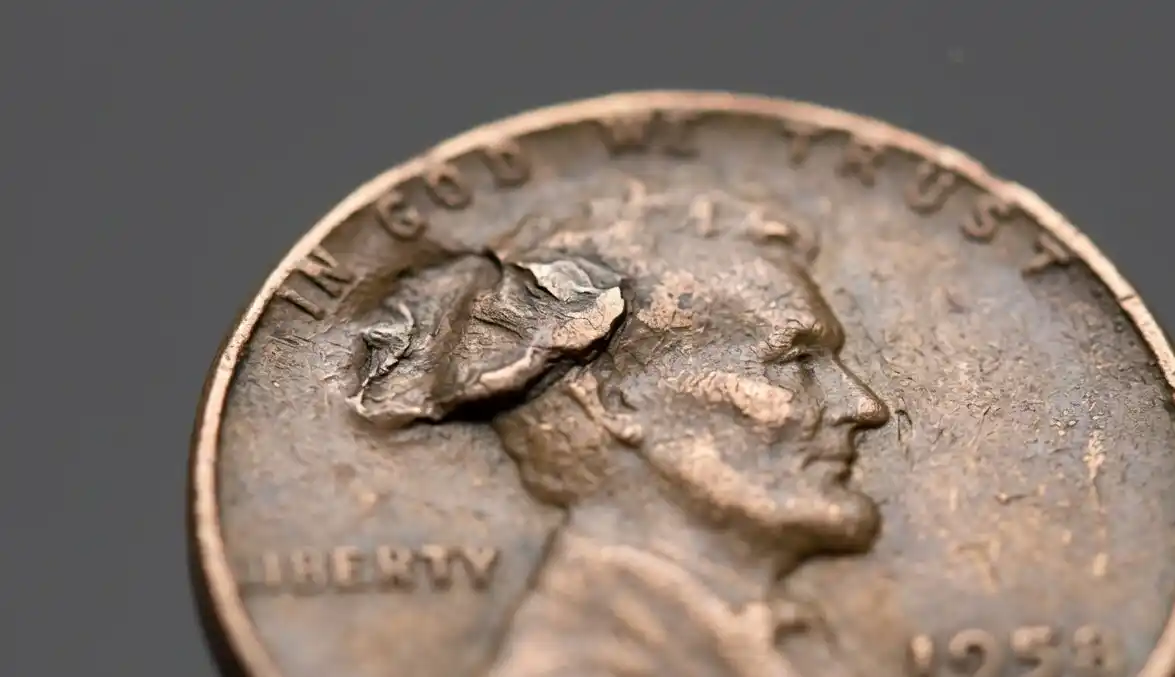
Poor preparation of metal sheets leads to fragment peeling.
Surface bubbles indicate gas presence trapped inside the alloy.
Such specimens were often ignored by the mass market until 2024.
→ Rising interest in structural anomalies
→ Formation of a separate collecting category
→ Increase in auction starting prices by 20%
Demand shifts from perfect forms toward visually aggressive defects.
Logistics and Storage Conditions
Copper interacts actively with the environment, changing the chemical makeup of the surface layer.
Maintenance of 20 degrees Celsius temperature remains mandatory.
Humidity levels must not exceed 35%.
Applying safe equipment with inert gas protects assets valued over $5,000.
Transportation occurs in specialized boxes excluding vibration.
Holder damage during shipping reduces the final quote by 5%.
Comparative Analysis with 1955 Issues
The 1955 penny is famous for its large-scale doubled die.
Comparing 1955 and 1958 indicators reveals different dynamics.
Year
Type Popularity
Error Rarity
Investment Risk
1955
Maximum
Medium
Low
1958
Low
Extreme
Medium
Investing in 1958 requires more time for liquidation due to a narrow participant circle.
High entry costs for the DDO 1958 category exclude casual buyers.
Recent Quarter Auction Trends
Last trades confirm price stability for 1958 copper.
Heritage platform sales for February 2026:
Lot 4321: 1958-D MS66 Red — $145
Lot 4322: 1958 Phil Off-Center 15% — $55
Lot 4323: 1958 DDO Authentic — $1,380,000
Capital inflows from precious metal segments into rare numismatics are observed.
Copper cents serve as an inflation hedging tool.
Successful transaction rates exceed 92% of total listed lots.
Development Forecast through 2028
Mathematical modeling indicates a continued upward trend.
Decreasing amounts of uncertified material stimulate price growth for weak grades.
Future value influence factors:
Global price index for raw copper
Activity of Asian investment funds
Digitization of ownership registries
Expected growth for top grades averages 5.5% per year.
Demand stability is ensured by the historical significance of the final Wheat cent year.
Wrong Planchet Error Analysis
Rarest cases involve a penny struck on 10-cent planchets.
Such a coin features a white color and smaller diameter.
Cost for these units in 2026 starts at $12,000.
Metal composition determination uses X-ray analysis methods.
Weight matching the silver coin mass confirms error authenticity.
The market for these artifacts remains closed to public access, operating through private deals.
Corrosion Impact on Liquidity
Green spots appearing on copper signal irreversible structure destruction.
Coins showing environmental damage lose up to 80% of market price.
Professional restoration is permitted only in certified centers.
Independent cleaning with abrasives destroys numismatic value.
Buyers in 2026 prefer original patina over any intervention types.
Rare Specimen Search Methodology
Bank bag searching remains the primary source for finds.
Search efficiency averages 1 rare specimen per 50,000 checked units.
Inspection algorithm:
→ Evaluation of general edge condition
→ Verification of side symmetry
→ Usage of the free coin value lookup app
→ Microscopic study of the date
Using automatic scanners accelerates the process 15 times.
Equipment rental costs $100 per day.
Legal Aspects of Ownership
Coins with defects are recognized as legal tender in the USA.
Ownership rights are backed by certificates of authenticity.
Transaction taxation in 2026 depends on seller jurisdiction.
Profit from selling investment coins is taxed at a 15-20% rate.
Reporting operations exceeding $10,000 is a mandatory requirement.