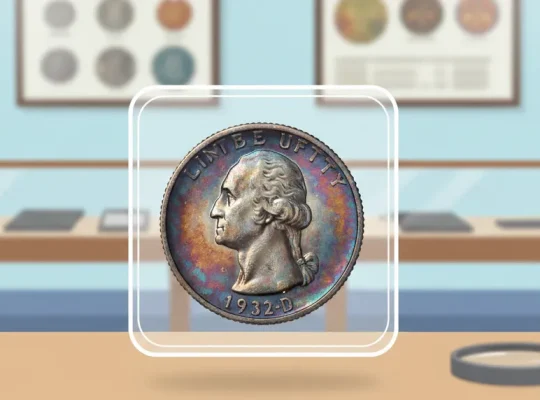

The main goal of this document is to explain clearly and simply how the worth is decided for three different types of modern coins made by mints: investment coins, collector coins having “proof” quality, and coins whose worth is set by a certification or checked by a coin checker, for example, “First Strike”.
Understanding these differences is important because each coin type has its main reason for existing, meaning it has a different main thing deciding its price.
Bullion
An investment coin, often called a “bullion” coin, the word “bullion” meaning a metal bar or precious metal in bulk, has one main purpose: working as a way to invest money in a precious metal.
The Main Factor for Worth
The worth of a bullion coin is decided almost completely by its weight and the clean quality of the precious metal used, being the material making up the coin.
- The biggest part of the coin’s worth is the price of gold, silver, or platinum on the world market right now, this price is called the “spot price”, growing if the gold price goes up, and falling if the gold price goes down, making the owner of such a coin own physical metal in a handy shape.
- Coins are made with a guaranteed exact weight, such as one troy ounce, and a high level of purity, for example, 999 or 999.9, this weight and purity being guaranteed by a government mint, proving the coin can be easily bought and sold.
- Bullion coins usually have a very small extra cost added for collectors, this extra cost being the money a buyer pays above the price of the metal itself, this small extra amount covering the mint’s costs for making the coin, sending it to sellers, and allowing a small profit for the seller, keeping the coin’s total price very near the metal’s market price.
The Making Process and Look
These coins are made, or “struck”, only one time using normal presses, the metal blanks, being the round metal discs, not being polished to a mirror shine, and the dies, being the molds for striking, also not being polished with the same high care used for “proof” coins.
Because of the mass production, small marks are allowed on bullion coins, these marks including tiny scratches, small uneven spots, or signs of hitting other coins, which often happen when the coins drop into containers right after being struck, these small faults not lowering the coin’s worth as metal, meaning a coin with the correct weight and purity is worth the same as any other identical coin.
Comparing with Collector Coins
- Purpose: Investing in the physical metal
- Price Setting: The metal price plus a small extra percent
- Example: American Gold Eagle, Canadian Silver Maple Leaf
- Keeping Time: The coin can be kept in a simple tube or even without one, its worth being decided by its weight
Proof
“Proof” quality coins are a special group made only for people who collect, their worth not being decided by the metal’s weight but by the perfect quality of their making, the low number of coins made, and their beautiful look.
The Main Factor for Worth
The worth of a proof coin is decided by how difficult it is to make and how few are made, not by the price of the metal inside.
- Proof coins are always made in a very small, controlled number, the fewer coins that are made, the higher their worth for collectors, this low number being the main reason their price is high.
- Collectors are willing to pay a high price for a coin looking totally perfect, unlike bullion coins where small marks are allowed, proof coins must be perfect, any tiny mark, scratch, or finger print greatly reducing their value.
The extra cost, or premium, for proof coins is much higher than for bullion coins, easily being hundreds or thousands of percent more than the metal’s spot price, for example, a gold proof coin costing three or four times more than a bullion coin of the same weight.
Striking
The process of making a proof coin is slow, involves many steps, and is expensive, this high cost justifying the coin’s high worth to collectors.
- The metal discs, soon becoming the coins, are polished by hand or with special machines until they look perfectly shiny like a mirror.
- The dies, being the forms, are also polished to create an ideally smooth, mirror-like background surface, the parts of the die forming the raised picture, for example, a portrait or an eagle, being treated with sandblasting or chemicals, giving them a matte or “frosted” texture.
- The coin is hit not just one time but two or more times at a slower speed and with more force than normal coins, ensuring all the smallest details of the picture are perfectly and clearly pressed onto the coin.
Every proof coin, right after being struck, is immediately put into a protective clear box or case, preventing any contact with the outside air or human hands.
Outer Look
Proof coins are easy to recognize because of their special finish.
- Mirror Surface: The background part of the coin must be completely smooth and shiny, looking exactly like a mirror
- Matte Picture: The raised parts, including the words, portraits, and designs, must look matte or slightly rough, this difference between the shiny background and the matte picture creating a very beautiful, deep, and high-contrast look, being the sign of “proof” quality
First Strike
“First Strike” coins are not a separate group based on how they are made, being normal coins, often bullion or simply coins that have not been used, gaining a high extra worth only through certification.
The Main Factor for Worth
The worth of a “First Strike” coin is decided only by the time it was bought and the documents given by an independent grading company.
- The names “First Strike” or “Early Release” are used by big independent grading companies, such as PCGS or NGC, the coin needing to be sent to the grading company and checked within the first 30 days after the official release date by the mint to get this certificate.
- The seller or dealer must give the graders written proof that the coin was received by them inside this 30-day time period, for example, the date on the shipping paper or post office stamp.
The coin’s worth goes up not because it was made better, but because of the special writing on the plastic holder, called a slab, given by the grading company, this writing, for example, MS-70 First Strike, making the buyer believe it is one of the very first coins to be sold.
And if you still haven’t figured out which coin you have, then the coin values app is quite suitable for the initial inspection.
Why This Adds Worth
Even though “First Strike” coins are technically the same as coins released 40 days later, this certificate adds value for collectors for several reasons.
- There is a common belief, sometimes true, that the dies used by the mint at the very beginning of the striking process are the newest and sharpest, meaning the very first struck coins should have the clearest details and the fewest marks, collectors being happy to pay for this chance of better quality
- The “First Strike” writing is a strong tool for selling, it creates a false “rarity based on time”
- Because these coins are sent straight to the grading company and sealed inside a plastic slab, they are guaranteed to have a certain very high condition level, often the highest one, MS-70, meaning “Perfect Unused”
Difference from Bullion and Proof
A “First Strike” coin is a bullion coin that has gone through an expensive extra process of time-based certification.
A “First Strike” coin can also be a “proof” coin if it was made as a “proof” and sent for grading in the first 30 days, but usually, a “First Strike” is a normal investment coin, the main difference being that “proof” is about the making method, and “First Strike” is about the time certification.
Separating Worth in Three Simple Points
Bullion is Weight: The worth is fully connected to the world market price of precious metals, meaning you buy metal, and the coin is just a handy and guaranteed metal container, the collector worth being very small.
Proof is Rareness: The worth is mostly separate from the metal price, being connected to the low production number and the artistic quality of the making, meaning you buy a collector item, being an example of coin art.
First Strike is a Time Certificate: The worth is connected to the fact of buying early and having an independent company or a coin value checker app prove the coin is in the best possible preserved state, often MS-70, this proof being made within 30 days of release, meaning you pay for a guarantee of time and quality.